Q&A with Mothebe Awer.org

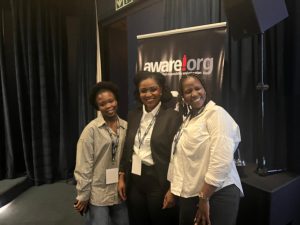
Take a pause and reflect, and we just look forward to what’s next in 2026?
Q- What excites you the most in regards to the multiple projects that you guys will be spearheading?
A- You know, it’s really difficult to say, but what I can say is that, as you can see or if you saw some of the videos — there’s this intersection between Node218 as well as FASD. So, we had a number of roundtables this year. We had a FASD roundtable, and we had a Node218 one last year.
One of the learnings, because we had multiple partners in those rooms, was identifying gaps around:
• What is the gap?
• How can we create the collaboration?
• How can we better communicate FASD?
• How can we better get ahead of FASD and prevent the numbers?
So in this year, 2025, we piloted a program with UJ, where we decided to speak to varsity students to look at young people even before they start thinking about starting families, male and female.
Before they even think about that stuff, to plant awareness and education so that when it is time to start a family, they have this knowledge in their head: do not drink during pregnancy; it is not safe to drink during pregnancy.
Then we realized there’s actually a gap in the adolescent education space. Just like we teach young people in school about safe sex, non-risky behaviours, don’t drink under 18… In South Africa we know a lot of people in high school are already over 18.
But in that space, there’s also a chance to talk about FASD to get them while they’re still adolescents, to get them while they’re still young.
Because the big problem with FASD is that lots of people don’t even know it exists. Never mind that it’s 100% preventable. Never mind that it’s irreversible.
Once your child is FASD-affected, there’s nothing you can do about it, and it’s a lifelong condition.
Can you imagine the effects from an economic point of view on the country in terms of health, grants that are paid out, education?
Life is hard for a FASD-affected child, and we want to eliminate that.
So if we start getting young people to have a better relationship and understanding of alcohol at a young age, then we can start to change behaviour.
If I learn this stuff in primary school, then in high school I understand it more; by the time I finish school, I know I don’t want to make this choice.
Then:
• don’t drink and drive reduces;
• sober pregnancies increase.
So it’s that intersection.
It’s almost like “two birds, one stone,” though I don’t want to call it that because it can sound callous.
But looking at the intersections, you can have so much more impact with an audience you already have.
Q- And then now, I know we have challenges promoting responsible drinking in schools. Within schools, I know you’re doing some work there, But what about a child who goes back home and faces similar situations? Where does the community then keep the balance?
A- I understand what you’re saying. That’s why we call it a whole-of-society approach. You have to educate the child, the teacher, the caregiver and/or the parent.
That’s why we have partnerships with, for example, Skeem Saam — where the family sits together and watches the TV show, and the whole No Under 18 conversation comes up.
It opens space for intergenerational conversations. With a gaming platform like Roblox, you don’t actually speak about alcohol itself.
You create lessons around peer pressure and the drivers of underage drinking. You show — almost like a simulation — what happens if you make the wrong decision, without directly speaking about alcohol.
That also creates intergenerational conversations: the child is playing, the parent is watching, asking, “Has anyone ever tried to influence you to drink?”
Then programs like the one with Pick n Pay School Club — in five regions — where we create content for school distribution. 25,000 learners get reached.
Content goes to:
• the learner in class,
• the teacher (because teachers also sometimes have alcohol issues),
• the home (parents).
In that way, it is an all-of-society approach. With different programs, we look at how we can touch all of society so that the gaps connect and we tell a full story.
Can I also ask you:
This thing of kids getting educated at school — with the life we’re living nowadays —between parents at home and kids at school, which one is more challenging?
I feel like the kids are better because they get information at school. There’s peer pressure, and then there’s home. The home ones are hard-headed. They don’t want to listen. They normalize things — “that’s just how we live.”
The two highest causes of underage drinking are:
1. Peer pressure
2. Normalization — what they see at home, role-modeling, exposure.
And that’s why we must reach parents, whether directly or indirectly. We also have resources on our website — if you’re having problems with this, here’s where you can go.
About the mental health program is it for parents as well? No, we don’t run programs for them.
The mental health program is for under-18s.
We can’t be everything to everyone. We are not the silver bullet to life or alcohol abuse. We don’t claim to be. We are part of the solution.
That’s why we have to work with partners, find out what they’re doing in the space, and then see how we can collaborate.
We’re not here to fix the whole country. It has to be collaboration between government, private sector, public sector Together.
Q- So with the collaborations that exist, the goal is to bridge the gap.
Yes — we’re all trying to achieve one goal. We all want to get there. Sometimes someone has the vision but not the resources. Someone else will say, “We have what you need.” It takes a village.
If you look at our partnerships with metro departments — what we do is enable them to further the work they’re already doing.
We help them increase:
• the number of roadblocks
• by giving blood kits
• breathalyzer test kits
• EVAT machines
• data capturers
• community education materials
They would be doing their work anyway, but we know they have challenges. We help fill some of those gaps.